
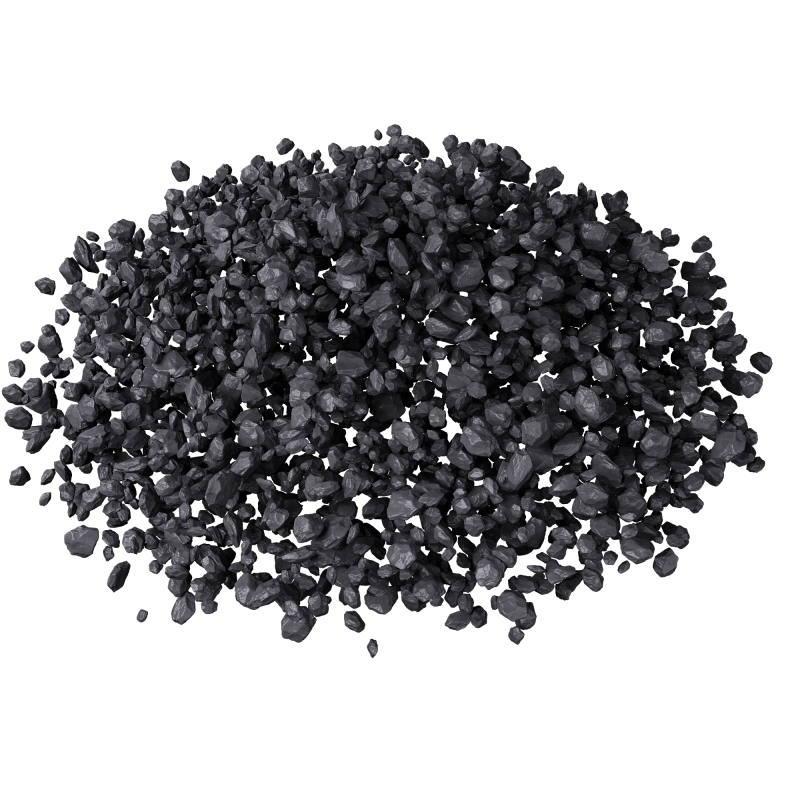
Calcined Petroleum Coke
- Petroleum coke is a byproduct of crude oil refining, with carbon as its main component. Calcined petroleum coke is obtained by performing a calcination process on raw petroleum coke. During this process, part of the volatile materials and moisture in the raw coke is removed, resulting in an increased carbon content by weight.
- Calcined petroleum coke is used in the steel industry. This product is also referred to as high-sulfur petroleum coke.
Petroleum coke is a byproduct of crude oil refining, with carbon as its main component. Calcined petroleum coke is obtained by performing a calcination process on raw petroleum coke. During this process, part of the volatile materials and moisture in the raw coke is removed, resulting in an increased carbon content by weight.
Calcined petroleum coke is used in the steel industry. This product is also referred to as high-sulfur petroleum coke.
This type of coke is a byproduct of crude oil distillation, obtained at the bottom of the distillation column. During the production process, raw coke is eventually converted into calcined coke, which has a high fixed carbon content, low ash, and very low sulfur.
Due to the very high thermal conditions in which petroleum coke is produced, it contains very little volatile combustible material. It should be noted that this coke is used in many applications, including electrodes and anodes, and is also widely used as fuel in the steel industry.
In other words, petroleum coke is a relatively inexpensive material with high calorific value and chemically stable carbon content, making it an efficient and economical fuel. Since most of its content is carbon, it burns and provides the required heat without causing significant pollution.
Some of the most important features of petroleum coke are:
- Has a distinct and toxic odor and is highly flammable
- Produced from processed coal tar
- Exhibits excellent adhesion, and resistance to water, oil, and various chemicals, which makes it superior to petroleum resin pitch in these properties
Chemical Composition of Petroleum Coke
The composition of this material is as follows”
- Carbon: 90–95%
- Sulfur: up to 3%
- Hydrogen: more than 1%
- Combination of Nitrogen and Oxygen: approximately 1.5%
- Various metals
Role of Petroleum Coke in Graphite Electrode Production
Petroleum coke can be used to produce graphite. As you know, graphite is the primary material used in the production of graphite electrodes for electric arc furnaces in the steel industry.
It should be noted that the properties of these electrodes depend heavily on the quality and purity of the petroleum coke used. For example, graphite electrodes with low thermal expansion coefficient and high-temperature resistance are in high demand in the steel industry compared to other graphite electrodes.
Coking Process
Coking is a process in which liquid raw materials are heated at very high temperatures. The result of this process is the formation of a solid deposit called petroleum coke. In simple terms, coke is a hard carbonaceous material that is baked at high temperatures in special furnaces and artificially produced.
Calcination Process
Calcination is a high-temperature heating process used to remove remaining volatile materials from raw petroleum coke production. Calcined petroleum coke (CPC) is a solid carbon material obtained from the distillation of green petroleum coke (a byproduct of petroleum distillation) at temperatures between 1250–1400 °C in rotary kilns or rotary chimneys at a controlled rate. The most important characteristic of this coke is its high carbon content and low ash content.
Structure of Calcined Petroleum Coke (CPC)
The structure of calcined petroleum coke (CPC) consists of graphite crystal arrangements with various shapes, orientations, and sizes, which pass through pores whose dimensions vary depending on the purity, process conditions, and residual characteristics of the crude oil from which the calcined coke is derived. The degree of crystallinity or structural order, and consequently the physical-chemical properties of calcined petroleum coke (CPC), is primarily determined by the composition of these residues.
Applications of Calcined Petroleum Coke (CPC) in the Steel Industry
- Induction Furnaces and Basic Oxygen Furnaces (BOF)
- Electric Arc Furnaces (EAF) and Ladle Furnaces (LF)
- Production of Graphite Electrodes for electric arc furnaces and ladle furnaces
It should be noted that calcined petroleum coke (CPC), which usually has low sulfur and metallic impurities, is used to manufacture anodes for the steel industry. These anodes must be dense, strong, electrically conductive, and have high carbon purity.
In the anode production process, calcined petroleum coke is mixed with coal tar pitch. According to the provided instructions, this material, along with coal tar pitch, is fed into a mixer and mixed at a temperature of 185°C. The resulting anode mass is sent to a hydraulic press to form “green” anodes.
Calcined petroleum coke is also widely used in the steel production industry.