
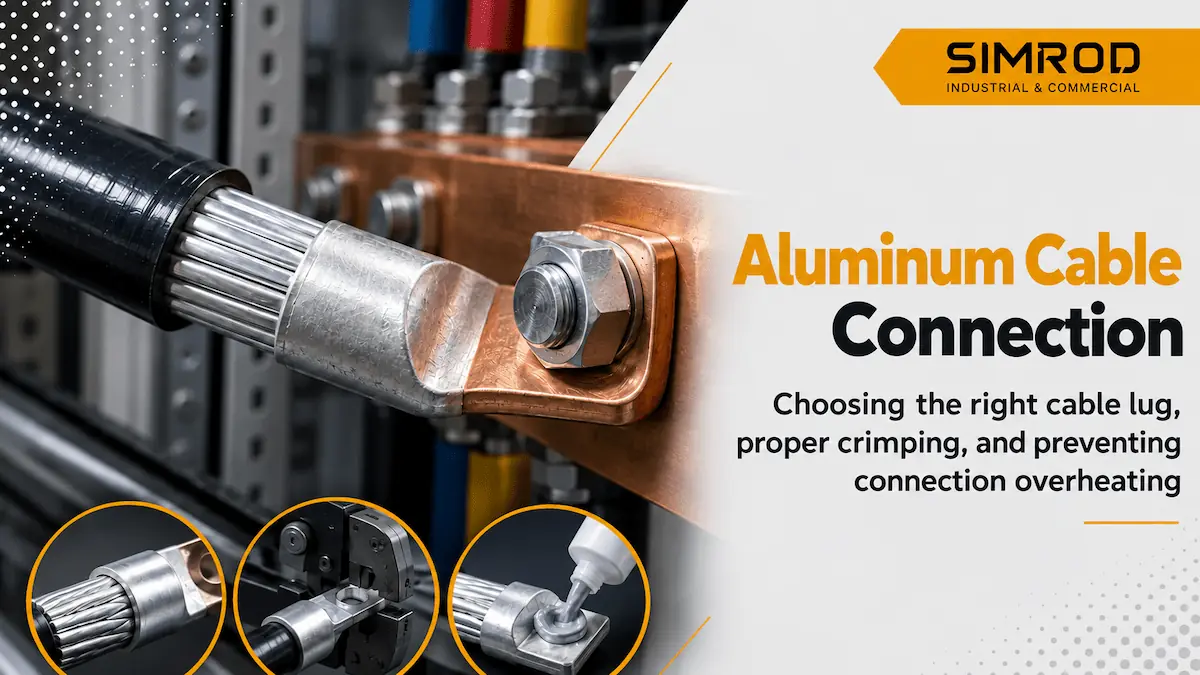
Aluminum Cable Connection: A Guide to Lug Selection, Crimping, and Preventing Connection Overheating
Selecting the correct cross-sectional area for an aluminum cable is only half the job. Even a standard cable with the correct cross-sectional area can develop increased resistance at the connection point if it is not properly installed at a panel, switch, transformer, or busbar.
The result may be overheating at the connection point, increased power losses, discoloration of equipment, insulation damage, or, in severe cases, connection failure.
This issue is particularly important with aluminum conductors because aluminum quickly forms an oxide layer when exposed to air. Its mechanical and thermal properties must also be considered when designing the connection. However, the presence of an oxide layer does not mean that aluminum connections are inherently unreliable. A properly designed mechanical or crimp connection can break through the thin oxide layer at the contact points.
In this guide, we examine how an aluminum cable should be connected, which cable lug should be used, where bimetallic lugs are applicable, and which common mistakes can cause the connection point to overheat.
Why Is Proper Aluminum Cable Connection So Important?
In an electrical circuit, the resistance of the cable itself is not the only factor that matters.
Connections are also part of the current path.
If the electrical resistance at a connection point increases excessively, according to the relationship:
P = I²R
the power dissipated at the connection increases.
This relationship highlights an important point:
As current increases, its effect on the heat generated at a poor connection becomes much greater.
Therefore, a connection may appear to operate normally under a low load, but when the circuit is subjected to a higher load, the same point may become a source of excessive heat.
For this reason, when installing an aluminum cable, three elements should be considered together:
Proper cable + proper connection + correct installation
Why Is Connecting Aluminum Cable Different from Copper?
Aluminum and copper are both electrical conductors, but they do not have identical physical properties.
Three issues are particularly important when connecting aluminum:
1. Formation of an Oxide Layer
Aluminum forms an oxide layer when exposed to air.
This must be considered during connection design and installation. Technical sources in the electrical connection industry also emphasize the importance of surface condition, the number of contact points, and the proper use of oxide-inhibiting compounds.
2. Different Mechanical Behavior
Aluminum differs from copper in terms of mechanical behavior and thermal expansion.
Therefore, a terminal or cable lug designed for one type of conductor is not necessarily suitable for the other.
3. Connecting Aluminum to Copper
When two dissimilar metals, such as copper and aluminum, are used in the same connection, the design of the interface between them becomes particularly important, especially when environmental conditions may allow moisture or electrolytes to be present.
For this reason, approved equipment specifically designed for Al/Cu connections should be used. An aluminum cable should not simply be connected to any copper lug or terminal based on trial and error.
Some industrial cable lugs are specifically designed for connecting aluminum and copper conductors to equipment and are supplied with an oxide-inhibiting compound.
Which Cable Lug Should Be Used for an Aluminum Cable?
The answer depends on the connection point.
Three situations should be distinguished.
Aluminum Cable Lug
If the connection system is designed for aluminum, an aluminum cable lug can be selected according to:
- Conductor material
- Cross-sectional area
- Conductor class
- Crimping method
- Bolt diameter
- Manufacturer specifications
The important point is that the term “aluminum cable lug” alone is not sufficient for selecting the correct component.
The cable lug must be compatible with the conductor size, conductor type, and connection method.
What Is a Bimetallic Cable Lug?
A Bimetallic Lug is used when an appropriate interface is required between an aluminum conductor and the copper side of electrical equipment.
These lugs are designed so that the section connected to the aluminum conductor and the section connected to the copper equipment provide an appropriate interface between the two dissimilar metals.
One important application is connecting an aluminum cable to copper equipment or copper busbars.
Therefore, if your cable is aluminum but the equipment connection point is copper, you should not assume that any standard copper cable lug will be suitable without technical verification.
How Is an Aluminum Cable Connected to a Copper Busbar?
This is an important application in industrial projects.
Suppose an aluminum power cable enters an electrical panel while the busbar inside the panel is made of copper.
In this case, we have an:
Al → Cu
connection.
For such a connection, the selected component must be explicitly approved by its manufacturer for Al/Cu applications.
There are cable lugs and connectors on the market specifically designed for connecting aluminum or copper cables to equipment pads and transformers.
The exact component should be selected based on:
Cable lug datasheet + conductor specifications + equipment manufacturer’s instructions
Can an Aluminum Cable Be Connected Directly to a Copper Cable Lug?
This should not be considered generally acceptable.
If the cable lug manufacturer has not explicitly approved the use of an aluminum conductor with that product, the fact that the cable physically fits inside the lug does not mean that the connection is electrically or mechanically suitable.
This is an important installation principle:
The fact that a conductor fits inside a terminal does not prove electrical and mechanical compatibility.
Always check the specifications printed on the component and the manufacturer’s datasheet.
If the connection is between aluminum and copper, use a suitable and approved Connector or Lug specifically designed for this application.
What Is an Oxide-Inhibiting Compound for Aluminum Cable?
Some connection systems use an Oxide Inhibitor or Joint Compound.
Such compounds may help protect the connection surface against environmental factors and help maintain connection quality.
For example, some commercial cable lugs designed for aluminum are factory-filled with an oxide-inhibiting compound. There are also specific compounds designed for aluminum-to-aluminum and aluminum-to-copper connections.
However, one important point must be emphasized:
Do not apply any grease or compound to the connection arbitrarily.
The use of a compound must comply with the connector manufacturer’s instructions. Even recommendations concerning conductor brushing and the use of an oxide inhibitor depend on the specific connector and its installation instructions.
Therefore, the correct rule is not:
“Always apply compound.”
Instead:
“Follow the cable lug or connector manufacturer’s instructions.”
Should the Aluminum Cable Surface Be Brushed Before Connection?
This should not be treated as a universal instruction for every type of connection.
In some systems, surface preparation or brushing is recommended according to the manufacturer’s instructions. In other pre-engineered connector systems, the installation procedure may be different.
UL-oriented technical sources also emphasize that brushing and the use of oxide inhibitors should be consistent with the connector manufacturer’s recommendations.
Therefore, before installation:
Read the cable lug Installation Instructions.
This document is more reliable than generic recommendations found online.
How Is an Aluminum Cable Lug Crimped?
One of the installation steps where an execution error can compromise the connection is Crimping.
Proper crimping does not simply mean pressing a cable lug with any available tool.
Four components must be compatible with one another:
Cable + Cable Lug + Crimp Die + Crimping Tool
If a cable lug is designed for a specific cable size but the wrong die is selected, the final connection may not comply with the manufacturer’s mechanical or electrical design requirements.
General Steps for a Crimp Connection
The exact procedure must always follow the manufacturer’s instructions, but conceptually the process includes:
- Select the appropriate cable lug.
- Determine the correct stripping length.
- Remove the insulation without damaging the conductor.
- Prepare the conductor according to the manufacturer’s instructions.
- Insert the conductor completely into the lug barrel.
- Select the correct crimp die.
- Perform the crimping at the specified locations and in the specified sequence.
- Inspect the connection after crimping.
- Apply the required insulation or final protection.
The number and position of crimps should never be determined by guesswork.
The manufacturer’s Crimp Chart for the cable lug and crimping tool should be used as the reference.
What Is the Relationship Between IEC 61238 and Cable Connections?
The IEC 61238-1-1:2018 standard covers test methods and requirements for crimped and mechanical connectors for power cables up to 1 kV.
Its scope includes conductors compliant with IEC 60228, with nominal cross-sectional areas from 16 to 1200 mm² for aluminum. The standard establishes test methods and requirements for connectors used with copper and aluminum conductors.
Therefore, in professional projects, a connector is not simply a piece of metal. The electrical, mechanical, and thermal performance of the connection is important.
Why Does an Aluminum Cable Connection Overheat?
If a cable maintains a normal temperature along its length but only the connection point becomes excessively hot, high connection resistance is one of the issues that should be investigated.
Possible causes include:
Improper Cable Lug
The connector is not compatible with the conductor material, size, or conductor type.
Improper Crimping
The wrong die or tool was used, or the crimping operation was not performed according to the manufacturer’s instructions.
Improper Mechanical Connection
The bolted connection or terminal was not installed according to the required torque and installation instructions.
Improper Conductor Preparation
The connection surface or conductor was not prepared according to the connector manufacturer’s instructions.
Conductor Damage
Some conductor strands may have been cut or damaged while stripping the cable.
Environmental Conditions
Moisture, contamination, or corrosion may affect the connection in certain environments.
Overloading
The problem may not be limited to the connection. The circuit itself may be carrying a current higher than its design value.
Therefore, observing excessive heat alone is not sufficient to determine the cause. The connection and the overall circuit conditions should be investigated.
8 Common Mistakes When Connecting Aluminum Cables
1. Using Any Cable Lug That Fits the Cable
Physical dimensions are only one selection criterion.
2. Directly Connecting Aluminum and Copper Without a Suitable Connector
For an Al/Cu connection, connector compatibility must be verified.
3. Using the Wrong Crimp Die
A particular cable lug size is not necessarily compatible with every die of the same nominal size.
4. Crimping With an Incompatible Tool
The Tool, Die, and Lug form a complete connection system.
5. Applying Grease or Compound Without Manufacturer Approval
Only the material approved by the connector manufacturer should be used.
6. Cutting Conductor Strands During Stripping
Reducing the number of effective conductor strands can compromise connection quality.
7. Ignoring Bolt Torque
“More tightening is always better” is not a correct rule.
8. Failing to Inspect the Connection After Commissioning
In critical projects, thermal monitoring and inspection as part of a maintenance program can help identify abnormal connection points.
Can an Improper Connection Cause Voltage Drop?
Yes.
The resistance of the electrical path plays a role in voltage drop.
An improperly installed connection with abnormal resistance is also part of this current path.
Therefore, a cable may have an entirely appropriate cross-sectional area, but a poor connection can still cause:
Localized voltage drop + heat generation
Is Aluminum or Copper Better in Terms of Connection?
Copper and aluminum each have their own connection requirements.
It would be incorrect to conclude that an aluminum cable is an unreliable choice simply because it requires an appropriate connector.
Standardized connection systems for aluminum conductors are well established in the electrical industry. IEC 61238-1-1 itself specifies test requirements for connectors used with copper and aluminum power cable conductors.
Therefore, the better question is:
Are the cable, connector, and installation method designed and selected to work together?
rather than simply asking which conductor material is being used.
When Ordering an Aluminum Cable, Also Consider the Connection Equipment
This point is particularly important for project procurement departments.
When purchasing a cable, the following should not be the only specifications defined:
Cable type + cross-sectional area + length
It should also be determined in advance what equipment the cable will be connected to.
For example:
- Electrical panel
- Copper busbar
- Transformer
- Switch
- Busbar system
- Another cable
When the other side of the connection is known, the project engineer can determine the appropriate connector and accessories before installation.
This helps prevent a situation in which hundreds of meters of cable arrive at the project site only to discover during installation that the appropriate cable lug or connector has not been specified.
Aluminum Cable Connection Checklist
Before making the connection, check the following:
| Item | Verification Question |
|---|---|
| Conductor | What are the conductor material and cross-sectional area? |
| Cable Lug | Is it approved for Al or Al/Cu applications? |
| Size | Is it compatible with the conductor cross-section? |
| Tool | What is the approved crimping tool? |
| Die | What is the correct die number/size? |
| Preparation | What does the manufacturer’s installation instruction specify? |
| Compound | Is it required? If so, what type? |
| Bolted Connection | What is the required torque? |
| Environment | Is protection against moisture required? |
| Final Inspection | Has the connection been inspected after installation? |
Purchasing Aluminum Cable for Industrial Projects
Connection quality cannot be separated from cable quality. However, a proper connection cannot compensate for a cable that is unsuitable for the project.
First, the cable should be selected based on:
- Cross-sectional area
- Required current
- Voltage drop
- Number of cores
- Insulation type
- Installation conditions
- Project standards
Then, the appropriate connection system should be selected.
When requesting a quotation from Simrod Sama, it is recommended to provide the required cable length along with the cable type, number of cores, cross-sectional area, voltage, and project specifications.
Frequently Asked Questions About Aluminum Cable Connections
Which cable lug is suitable for an aluminum cable?
The cable lug must be approved for the intended aluminum conductor, cross-sectional area, and conductor class. The connector manufacturer’s specifications should be used as the selection reference.
What is a bimetallic cable lug?
A bimetallic cable lug is a connector designed to provide an appropriate interface between aluminum and copper in applications such as connecting an aluminum cable to the copper side of electrical equipment.
Can an aluminum cable be connected to a copper cable lug?
This should not be done without approval from the connector manufacturer. For an Al/Cu connection, use a component specifically designed and approved for this application.
Is an oxide-inhibiting compound necessary for aluminum cables?
There is no single rule that applies to all connectors. Some cable lugs are supplied from the factory with an oxide inhibitor, while in other applications the connector manufacturer’s installation instructions must be followed.
Why does an aluminum cable lug overheat?
Abnormally high connection resistance, an unsuitable cable lug or crimp, improper mechanical connection, conductor damage, environmental conditions, or overloading are among the factors that should be investigated.
Does more crimping always produce a better connection?
Not necessarily. The number and position of crimps must follow the cable lug manufacturer’s instructions and the specifications of the crimping system.
What is the standard for aluminum cable connections?
Different standards may apply depending on the connector type and voltage level. IEC 61238-1-1:2018 is one of the relevant standards for crimped and mechanical connectors used with power cables up to 1 kV and includes aluminum conductors within its scope.
Conclusion
An aluminum cable connection is not a minor detail at the end of the cabling process. It is an integral part of the electrical design of the circuit.
Keep these three principles in mind:
The cable lug must be compatible with the conductor.
Crimping must be performed using the specified Tool and Die.
For aluminum-to-copper connections, Al/Cu compatibility must be specifically verified.
The use of oxide-inhibiting compounds, surface preparation, and the crimping method should not be determined simply by common installation habits. The connector manufacturer’s instructions should be the primary reference.
IEC 61238-1-1 also demonstrates that the performance of connectors for copper and aluminum conductors is subject to specific electrical and mechanical testing. A reliable connection is therefore not simply a matter of mechanically fastening two pieces of metal together.